
What is a Cell?
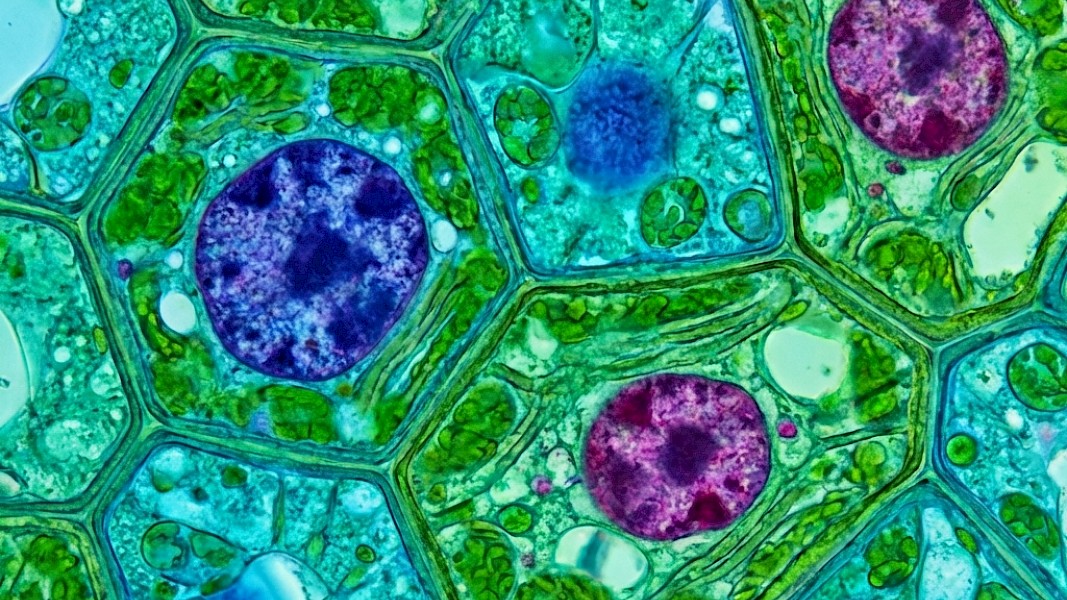
Every living thing is composed of cells, the microscopic building blocks of life. In fact, most life forms exist as single cells that carry out all functions needed for their own independent existence. Examples of common single-celled organisms are bacteria (tiny organisms found in almost every habitat on Earth), diatoms (algae that are common components of phytoplankton), and yeast (a kind of fungus). Multicellular organisms consist of several to many cells. Single-celled and small multicellular organisms, which must be magnified to be observed, are called microbes or microorganisms.
Plants and animals are examples of multicellular organisms visible to the naked eye. These macroscopic multicellular organisms can have up to trillions of cells that carry out specialized functions.
This activity uses plant cells, because many of these are relatively easy to see. Students will observe onion cells (in the thin membrane around each onion “ring”) and a leaf from Elodea. With these examples, students will be able to see basic parts of cells, including the nucleus (structure in the center of the cell that holds hereditary information), cytoplasm (gel that fills the cell), cell wall (rigid outer boundary of plant and other kinds of cells), and chloroplasts (large green structures in which photosynthesis occurs).
Cells are the fundamental building blocks of all living organisms. For students in Grades 3-8, the focus should be on understanding that all life is cellular and that cells perform specific functions to keep an organism alive. Key concepts include cell theory—the idea that all living things are made of cells and that cells come from other cells—and the distinction between single-celled and multicellular organisms.
Teacher Background
Cells are the fundamental building blocks of all living organisms. For students in Grades 3-8, the focus should be on understanding that all life is cellular and that cells perform specific functions to keep an organism alive. Key concepts include cell theory—the idea that all living things are made of cells and that cells come from other cells—and the distinction between single-celled and multicellular organisms.
Learning Objectives
-
Identify the primary differences between plant and animal cells.
-
Describe the function of major organelles, such as the nucleus, mitochondria, and cell membrane.
-
Demonstrate how to use a microscope to observe cellular structures.
-
Compare prokaryotic and eukaryotic cell types.
-
Materials
-
Compound microscopes
-
Prepared slides (onion skin and human cheek cells)
-
Glass slides and coverslips
-
Methylene blue or Iodine stain
-
Cell diagram handouts
-
Procedure
-
Introduction: Begin with a brief discussion on what makes something "alive" and introduce the cell as the smallest unit of life.
-
Guided Observation: Walk students through the parts of a microscope and how to focus on a specimen.
-
Lab Activity: Have students observe prepared slides and sketch what they see in their science journals, labeling parts they recognize.
-
Group Discussion: Compare sketches of plant vs. animal cells, highlighting the cell wall and chloroplasts in plants.
-
Assessment
-
Matching Quiz: Students match organelle names to their specific functions (e.g., Nucleus = "The Brain").
-
Lab Report: Review student sketches for accuracy and proper labeling.
-
Exit Ticket: Ask students to name one organelle found in a plant cell but not an animal cell.
-