
What is a Cell?

A sunny day with plants on the patio. 
A sunny day with plants on the patio. Attribution: Travis Kelleher [Music]so we've been talking about the brain with which sits in the skull but when you look at a person only only three pounds of them is their brain and then you've got the rest of this bodywell it turns out that the brain is the mission control center that's where everything is getting directed that's where the information is coming in and decisions are getting made and then the rest of the body is just being driven around by the brain the rest of the body is like a marionette being driven by the brainthere's a bundle of nerves that exits the brain that's called the spinal cord just think about it as a big data cable it's carrying all the information from your brain and that data cable Goes Down And Then There are little smaller cables that that reach out from from your back and talk to everything talk to every muscle in your body talk to every internal organ in your body the whole system is connected by these data cablesthat end up coming all together and and feeding the brain and of course it's a two-way communication so the brain is sending data out causing things to happen and it's getting feedback it's finding out what's being felt what's being seen heard all these things are coming back up into the brain so that's the way to think about it it's the mission control center that's sitting in its armored bunkerand uh taking in the information from the world deciding where to go next sometimes in Neuroscience we we joke that uh that the rest of the body exists just to carry the brain around from place to place and it's sort of like that it's uh it's it's like this little operator up there that gets to drive around this giant robotnow when you look at the human brain it looks about the same everywhere but in fact it's not it's quite specialized and as you move over the different territories of the brain you find that there are very different things going on so at the largest level we have a difference between this part of the brain which is called the cerebrum that's the main part of the brain and then this little part down here which is called the cerebellum which stands for little cerebrumand the cerebrum this part here is really where the thinking takes place and the sensory experiences take place the cerebellum is mostly involved in motor coordination and making your uh ability to balance and to play the piano and to do fine motor actions the cerebellum helps with that but when you think about who you are as a person that's mostly up here in the cerebrumnow the cerebrum looks like it's all the same but in fact it's not this is the back of the head that we're looking at and up here is the front and it turns out that essentially the back half of the brain that's where things are taking place in terms of your sensory systems this is how you get your Windows onto the world you're seeing the world through your eyes you're hearing through your ears you're feeling it through your fingertips and all of that information comes into the back of the brain here and that's where that gets processedthe front half of the brain is really more what we associate with the long-term thinking and decision making and the kinds of choices you make that determine who you are as a person most of that happens in the front of the brain so there's a sense in which the front half is watching what's happening in the back half and making sort of a longer term assessment of what's going on and what to do about that given the information coming in from the outside world here in the back half of the brainit turns out that different parts of the brain develop at different rates and so um by the time you're a young child the parts of your brain involved in understanding sensory information those have already come into place pretty well um but the parts of your brain in the front that are involved in very long-term decision making and in squelching impulses in order to make a long a better long-term decision those parts of the brain develop slowly and they don't reach full maturation until the age of about 20 or 21 and this is why for example car insurance companies will charge more for young drivers than for adult drivers because adult drivers have a different style of decision-makingas a result of the development of this part of the brain and in fact when we look at the legal system the same sorts of rules apply children are treated very different from adult and it's because children's brains and adult brains really are somewhat different and it's because of the slow maturation the slow development of the front partthe outer layer of the brain here is called the cortex and that's Latin for bark it's like the bark of a tree and it's very thin it's only about 3 mm and it's the wrinkly part that you see on the outside of the brainnow why is it wrinkled it's because humans have a lot of Cortex we have more than most of our cousins in the animal kingdom and so the only way to fit that all into our small heads is to crumple it up the way you would fit a newspaper into a smaller container okaynow if you were to take the human cortex and and unravel it and pull it straight it would be about the size of a medium Pizza Pie and and so there's a lot that's packed in there if you were to take a our near cousins if you were to take a monkey for example and unravel its cortex it's like a personal pan pizza it's a much smaller bit there about a quarter of the size and the cortex is really where all the magic is happening in terms of thinkingnow below the cortex there are all sorts of other very important functions happening these have to do with things like breathing and heartbeat and keep keeping your temperature straight and letting you know when you're hungry all sorts of very important things and we'll talk more about those later but the cortex the outer part is really the magical stuff that determines your ability to think through a problem and make the right sorts of decisions and to sense the world to have a sensory experience of watching a sunset or or tasting feta cheese or feeling velvet in your fingertips these all require the cortex to be in placeso when we zoom in on the details of what's happening in the cortex you find that different regions are specialized for very particular things so for example the back part of the brain here is specialized for vision so even though your eyes are in the front that information crosses the entire territory of the brain and ends up being processed in the back of the brain on the side here is where hearing takes place this is the where the information that comes in through your ears actually also goes across the brain and gets uh gets processed here in the auditory cortex as it's calledalong here is the part that processes all the signals from your body so your skin is one giant sheet of of sensor material essentially and so everything it it it uh senses touch and vibration and heat and all that information streams back into your brain and it's this part of your brain where that's getting processedand in this intermediate territory that's where all of those senses come together and that's why when we experience the world it's what we call multi-sensory it's in that fashion we don't just see things and hear them and and touch them separately but we actually When We Touch things have a sense of hearing it and feeling it and seeing it all at the same time it feels like a single unified experience so you have parts of the cortex that are very specialized and then all the rest of the cortex is where that information flows together and we have this multi sensory experience of the world [Music]QA-MATRIX-1790268339205-reedit-video Summary of "Staying Fit in Space"
In the podcast, Benjamin D. Levine, MD (a scientist with the National Space Biomedical Research Institute), discusses the physiological challenges of microgravity and the strategies used to combat them.
The Problem: Lack of "Good Stress"
On Earth, gravity provides constant "stress" on our bodies. In microgravity (like on the ISS) or low gravity (Moon/Mars), this stress is removed, leading to:
Muscle Atrophy: Muscles shrink because they aren't working against gravity to move the body.
Bone Demineralization: Bones lose calcium and density, becoming brittle.
Cardiovascular Changes: The heart doesn't have to pump as hard to move blood upward, leading to "cardiac stiffness" or shrinkage over time.
The Solution: Exercise Countermeasures
To stay fit, astronauts must simulate Earth's gravity through intense daily exercise (often 2+ hours a day). Key equipment mentioned includes:
Bicycle Ergometers: For cardiovascular health.
Treadmills with Bungees: Astronauts are strapped down with elastic cords to simulate weight so they can "run."
Resistance Devices: Specialized machines (like the ARED) that use vacuum cylinders to provide heavy resistance for strength training.QA-MATRIX-1790268339205-reedit-audio In the podcast, Benjamin D. Levine, MD (a scientist with the National Space Biomedical Research Institute), discusses the physiological challenges of microgravity and the strategies used to combat them.Available Video Sources:So the human brain consists of about 10 billion neurons. Neurons are the specialized cell types in the brain andevery single neuron in your brain is about as complicated as New York City. Every single neuron has the entireHuman Genome in it. It's trafficking millions of little molecules and proteins around in very complicated interactions and you've gottens of billions of these. So you can see it's an extremely complex system and in fact every neuronis connected to about 10,000 other neurons that it communicates with.The most important type of cell in the brain is what's called a neuron. Now a neuron is likeany other cell in your body except that it has these specialized arms that come off of it and reachout and talk to other neurons. And what's also special about neurons is that they can make these littleelectrical pulses and those pulses travel out to carry their signal to other neurons. So these pulses are calledAction Potentials, although we typically just call them spikes, and these are somehow the language of the brain. They're theselittle all-or-none electrical pulses. They're always the same size, the same length, and they travel out and somehowthis is the alphabet of the brain, even though we don't quite know how to read the language yet. Inany case, when you look at the brain what you have are tens of billions of these neurons and they'reall chattering with spikesâthey're all firing these little signals at the same time in very complicated patterns and thatsomehow translates to vision and hearing and thought and decision-making and so on. It's these electrical signals that travel veryrapidly around the whole network of the brain.So when you look at a neuron with all of these arms coming off of it, one arm isspecialâit's not like the other ones. That one's called the axon, and that's the one that carries the electricalsignal. It's the wire that carries that electrical signal. Now what happens when that electrical signal reaches the end ofthe axon? What happens is that causes the release of little chemicalsâthese are called neurotransmitters because they're transmittinginformation to the next neuron which is sensitive to these little chemicals. So the first neuron pops an electrical signalwhich travels along, causes the release of chemicals, and then the other neurons over here detect those chemicals and thatcauses them to make electrical signals and then those pass along. So the way that signals move in the brainis a combination of electrical signals and then little chemical puffs that carry information to the next neurons. And whatyou have when you look at 10 billion of these with 100 trillion of these connections is a very complicatednetwork going on all the time. If you could translate every one of these electrical pulses in your brain intoa little sound like *click*, it would be deafening. There are trillions of these happening every second. So if youever feel lazy or dull, don't lose heart, because you're the busiest, brightest thing on the planet.Even though neurons get the most attention because they're the ones that carry these rapid electrical signals, there isanother type of cell in the brain called the glial cell, and these turn out to be 10 times morenumerous than neurons. They don't get much attention because they're much quieterâthey don't do exciting things like carry signalsaround. Nonetheless, glial cells are a very important part of what the brain does. Glia is Latin for the word "glue,"and the reason it got that name is because it's sort of the cell type that holds everything together. Insome sense, the glial cells are there to set up the conditions for these neurons to do their fast communication.QA-MATRIX-1790268339205-reedit-ext_video Neurons are specialized cells that process and transmit information to other cells. The nervous system also contains glial cells, which are critical to the brain's function and development.
Dr. David Eagleman is a neuroscientist and best-selling author at Baylor College of Medicine (BCM), where he directs the Laboratory for Perception and Action, and the Initiative on Neuroscience and Law. Best known for his work on time perception, synesthesia, and neurolaw, Dr. Eagleman appears regularly on radio and television to discuss literature and science.
Your Brain is You was produced by BCM's Learning Brain project, which is developing interdisciplinary neuroscience teaching materials for BioEd Online (www.bioedonline.org). The project is supported by a grant from the National Institute on Drug Abuse of the National Institutes of Health (NIH) and the SEPA program, Office of the Director, NIH.Available Video Sources:So how do we optimize learning? How do we make it so that what we do in a classroom isreally the best thing we can be doing, given what we know about the brain? So there are many ideas out there.For example, listening to classical musicâdoes that actually make a child smarter? The answer turns out to be no.Simply listening to the music does not change anything about how a kid turns out, with one exception:it turns out that kids who listen to classical music might be more prone to take up playing a musical instrument,and that ends up enhancing a child's intelligence. Why? Well, to play a musical instrument well requires a lotof practice and concentration, and these are skills that are useful for becoming a good learnerâfor being able topay attention to something for a sustained period of time. This is, of course, one of the challenges for all of usin this digital age: how to sustain attention for a period of time because there are so many pullson our entertainment time at this point. And so this is one of the things that's important to teach to children.Now the main way that learning gets into the brain is by engagement in the material.The ancient Greeks had noted thisâthat in order to retain any information you really have to be curious about it.You need to care about it in some way. And this is the sort of central point that we always need to be thinking aboutwhen we're teaching: how do we engage the students? So anytime we're just telling them material to memorize,it's more of a challenge to make them engaged. And so the trick for all of us is to figure out what can we doto make it interactive and emotionally salient and memorable to them. That's the way to get informationinto the brain. And I think we have lots of opportunities now in this era that we never had beforeby leveraging adaptive software and other educational games that keep a student right at his or her pointof struggle, where things are frustrating but achievable, and they can level up as they achieve the next step and so on.Um, that's a real opportunity for us to take advantage of that because really the way classrooms run typically isit's going too fast for half the kids and too slow for the other half of the kids. So anytime there's a wayto leverage the opportunities around us to make it more customized for each child, then that's a great thing for usto take advantage of. And the way to do that, I think, is with software that essentially puts a different skinon what you're trying to teach. So for example, with mathematics: some kid is going to love baseball,and that's the way he's going to get into math is by trying to understand the baseball statistics.Someone else is going to love space and the planets, and that's the way to get her into math is by giving hersome game that involves that, and so on. And we have this opportunity nowâinstead of giving every kidthe same homeworkâinstead to say, "Look, your homework tonight is to get two levels up from where you are right nowin the game," irrespective of where each child is individually.So many people wonder about this idea that they've heard that the right and the left halves of the brainare very different from one another and that you're a "right-brain thinker" or a "left-brain thinker," and it turns outthat the two halves of the brain are more similar than they are different. So it's a little bit of a misconceptionto think that the right and left halves are somehow fundamentally different. It is true that the left halfis more involved in language and in fine motor skills, and the right half is slightly more involvedin certain emotional issues and things like understanding music. But as I said, it's really about the balanceof the left and right activity rather than an all-or-none issue. And so when we talk about somebody beinga left- or right-brain thinker, that's probably a misconception that doesn't do us any good and would be betteroff left to the side.Young brains are the most able to take in new informationâto absorb thatâbut it turns out that sortof brain plasticity is not just for the young; it's retained throughout life. And in fact, one of themost important things as people get older and older is to keep their brains physically active, because by doing sothey're always building new roadways in their brain. They're always finding new ways to solve problems.And one of the problems that people get as they age is that parts of the brain might start to degenerateâthetissue actually starts to die. And so by keeping cognitively fit, you're always building new roadways and youcan continue to solve problems that way. So it's of utmost importanceâjust like any muscle in your bodyâtouse it so that you don't lose it.Students are better able to learn and retain knowledge when they are interested in a subject, challenged by content, and have a context in which to comprehend new information. Students are better able to learn and retain knowledge when they are interested in a subject, challenged by content, and have a context in which to comprehend new information.
Dr. David Eagleman is a neuroscientist and best-selling author at Baylor College of Medicine (BCM), where he directs the Laboratory for Perception and Action, and the Initiative on Neuroscience and Law. Best known for his work on time perception, synesthesia, and neurolaw, Dr. Eagleman appears regularly on radio and television to discuss literature and science.
Your Brain is You was produced by BCM's Learning Brain project, which is developing interdisciplinary neuroscience teaching materials for BioEd Online (www.bioedonline.org). The project is supported by a grant from the National Institute on Drug Abuse of the National Institutes of Health (NIH) and the SEPA program, Office of the Director, NIH.Summary of "Staying Fit in Space"
In the podcast, Benjamin D. Levine, MD (a scientist with the National Space Biomedical Research Institute), discusses the physiological challenges of microgravity and the strategies used to combat them.
The Problem: Lack of "Good Stress"
On Earth, gravity provides constant "stress" on our bodies. In microgravity (like on the ISS) or low gravity (Moon/Mars), this stress is removed, leading to:
Muscle Atrophy: Muscles shrink because they aren't working against gravity to move the body.
Bone Demineralization: Bones lose calcium and density, becoming brittle.
Cardiovascular Changes: The heart doesn't have to pump as hard to move blood upward, leading to "cardiac stiffness" or shrinkage over time.
The Solution: Exercise Countermeasures
To stay fit, astronauts must simulate Earth's gravity through intense daily exercise (often 2+ hours a day). Key equipment mentioned includes:
Bicycle Ergometers: For cardiovascular health.
Treadmills with Bungees: Astronauts are strapped down with elastic cords to simulate weight so they can "run."
Resistance Devices: Specialized machines (like the ARED) that use vacuum cylinders to provide heavy resistance for strength training.QA-MATRIX-1790268339205-reedit-audio In the podcast, Benjamin D. Levine, MD (a scientist with the National Space Biomedical Research Institute), discusses the physiological challenges of microgravity and the strategies used to combat them.
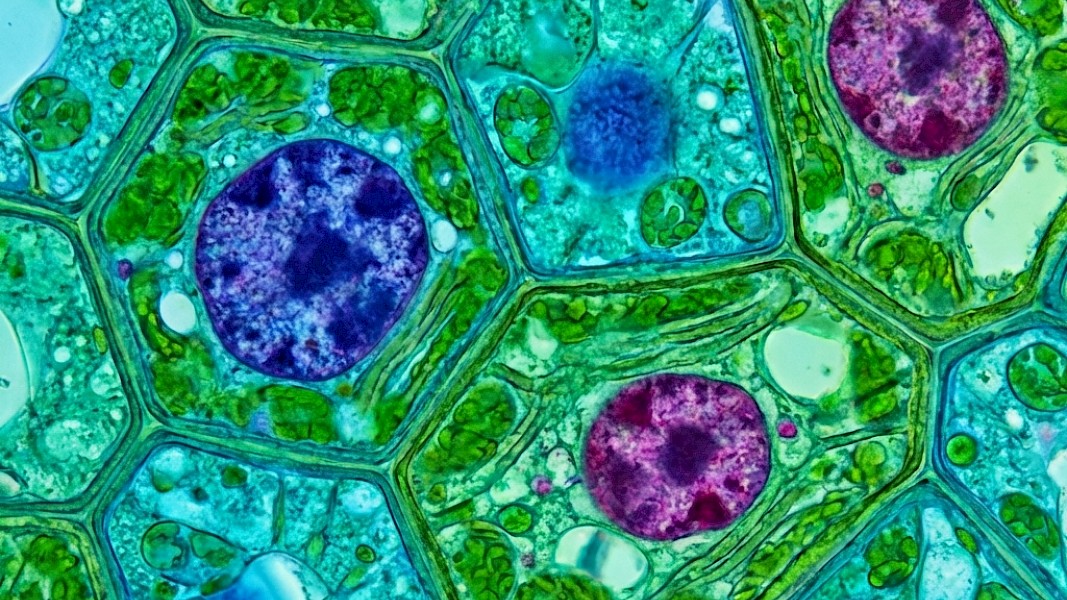
QA-MATRIX-1790268339205-reedit-image Cells are the fundamental building blocks of all living organisms. For students in Grades 3-8, the focus should be on understanding that all life is cellular and that cells perform specific functions to keep an organism alive. Key concepts include cell theory—the idea that all living things are made of cells and that cells come from other cells—and the distinction between single-celled and multicellular organisms.
Cells are the fundamental building blocks of all living organisms. For students in Grades 3-8, the focus should be on understanding that all life is cellular and that cells perform specific functions to keep an organism alive. Key concepts include cell theory—the idea that all living things are made of cells and that cells come from other cells—and the distinction between single-celled and multicellular organisms.
Learning Objectives
-
Identify the primary differences between plant and animal cells.
-
Describe the function of major organelles, such as the nucleus, mitochondria, and cell membrane.
-
Demonstrate how to use a microscope to observe cellular structures.
-
Compare prokaryotic and eukaryotic cell types.
-
Materials
-
Compound microscopes
-
Prepared slides (onion skin and human cheek cells)
-
Glass slides and coverslips
-
Methylene blue or Iodine stain
-
Cell diagram handouts
-
Procedure
-
Introduction: Begin with a brief discussion on what makes something "alive" and introduce the cell as the smallest unit of life.
-
Guided Observation: Walk students through the parts of a microscope and how to focus on a specimen.
-
Lab Activity: Have students observe prepared slides and sketch what they see in their science journals, labeling parts they recognize.
-
Group Discussion: Compare sketches of plant vs. animal cells, highlighting the cell wall and chloroplasts in plants.
-
Assessment
-
Matching Quiz: Students match organelle names to their specific functions (e.g., Nucleus = "The Brain").
-
Lab Report: Review student sketches for accuracy and proper labeling.
-
Exit Ticket: Ask students to name one organelle found in a plant cell but not an animal cell.
-
Test Assets

Photo Gallery

A sunny day with plants on the patio.
